
When everything is going well, it’s easy to forget the blows that can fall without warning: car breakdown, washing machine giving out, drop in income, period of unemployment. Yet these are the moments that make the difference between a situation under control and severe stress that wakes you at night. Emergency savings exist exactly for that: to absorb the shock without going into overdraft or scrambling for a last-minute loan. It’s not a financier’s whim — it’s a simple cushion that prevents you from getting hurt when you fall.
We are talking here about money set aside for the short term, available, without risk of loss, and placed on simple vehicles: Livret A, LDDS, fonds en euros of assurance vie. The goal is not to achieve the best possible return, but to have the right amount in the right place at the right time. A reserve that allows you to repair your car, pay for a move, or cover a few months in case of hardship, without begging your banker. The firmer this base, the easier it becomes to think about project savings and long-term investments afterwards.
In what follows, we’ll see how to define this safety cushion, how to calculate its amount, where to place it concretely, and how to adjust it when life changes: new job, child, property purchase. We’ll also take concrete examples of different profiles, like Samir the single person, Claire and Julien with two children, or Nadia the freelancer. The idea is not to aim for perfection, but to move forward step by step, with a simple, realistic method that is above all immediately applicable.
Understanding emergency savings: definition and essential role
Emergency savings, also called safety savings, refer to an amount of money set aside to absorb life’s unforeseen events. They are used to cover expenses that cannot be postponed: vet bill, broken boiler, partial loss of income, insurance deductible after an accident. This amount must remain accessible, without risk of capital loss, and without a complicated delay to access it.
Concretely, this savings is placed on simple vehicles with good liquidity, like the Livret A or the LDDS. The idea is to be able to make a transfer in a few clicks, day or night, without wondering if it’s the right time to sell or if the stock market has dropped. We’re not trying to beat records of return; we’re trying to protect ourselves.
In an overall personal finance management, emergency savings represent the foundational layer. Above that, we find project savings (rather medium-term) and finally long-term savings for retirement or investment. Without this foundation, every unforeseen event can force you to break an investment at the wrong time or give up an important project. The goal is to stop confusing “investing” with “ensuring the minimum vital needs”.
Key differences between emergency savings and project savings
People often mix up emergency savings and savings for projects. Yet their role is completely different. The first must remain totally available and stable. The second is used to prepare a trip, a car, a down payment on a house, or even investments for the more long term. Mixing the two creates confusion and encourages dipping into what should remain untouchable.
For projects, you can sometimes accept some blocking or volatility. For example, a fonds en euros in an assurance vie for an initial purchase in a few years, or slightly more dynamic investments for a more distant horizon. For emergency savings, it’s a no: guaranteed capital and simple access remain mandatory, even if the return is modest.
Imagine two separate envelopes. On the first, it says “vital emergencies”. On the second, “projects and wants”. As long as these two envelopes remain well separated, decisions are clearer, choices more serene, and hard times won’t erase years of preparation for a life project.
Primary objectives of safety savings in the face of financial surprises
Emergency savings have three main missions. The first is to cushion shocks: car breakdown, professional laptop to replace, dentist bill higher than expected. The second is to avoid costly emergency solutions like consumer credit or repeated overdrafts. The third, more invisible, is to reduce mental load and the feeling of vulnerability.
Take the example of Nadia, a freelance graphic designer. Without emergency savings, a single late payment can put her in difficulty to pay her rent. With three months of expenses set aside, she gains time to follow up with clients, negotiate, or look for a new contract without panic. This simple reserve gives her room to maneuver that changes how she lives her activity.
Ultimately, the objective of this savings is not to prevent all problems, but to avoid them turning into a financial catastrophe. It’s this difference between a hard time and a downward spiral that justifies placing it as a priority, before thinking about optimizing taxes or seeking a high long-term return.
Unavoidable benefits of a well-built emergency savings
Solid emergency savings act like a bumper. You still feel the impact, but you avoid the worst. When an unforeseen event happens, you no longer ask, “where to find the money?”, but “how to rebuild my reserve after using it?”. This change in perspective can be enough to avoid several revolving credits taken in haste.
This safety cushion also creates psychological space. Those who have known month-ends at zero know how much the slightest problem becomes a threat. When the reserve is there, even partially, you think differently. You can change jobs, train, or start a project without being paralyzed by the fear of running out at the first missed payment.
Avoid costly credit thanks to an effective emergency reserve
Without emergency savings, many households have only one solution in case of a shock: consumer credit or authorized overdraft. On paper, that seems practical. In reality, it’s paying each unforeseen expense with high interest, sometimes well above the interest rates offered on savings accounts. A €800 repair can turn into several hundred euros of additional fees.
With an emergency cushion placed on a Livret A or a LDDS, you reverse the logic. You pay the unforeseen expense with your own money, then repay yourself by refilling that account, calmly. You no longer suffer bank charges, you no longer negotiate with the bank in an emergency, and you keep control of the repayment schedule. The reserve, even modest, becomes a barrier against unnecessary debt.
Coherent emergency savings is not just a number of months of expenses. It’s a concrete tool to say no to easy solutions that cost a lot. Once you’ve tasted that freedom, returning to dependence on credit seems unthinkable.
Reduce financial stress and gain daily freedom of action
Money relates to security, family, and fear of tomorrow. When there’s no margin, every surprise bill can trigger tension in a couple, an argument, or simply a heavy silence. Emergency savings don’t remove problems, but they remove the layer of panic that always comes when the account is at zero.
With a few months of expenses set aside, a decision like leaving a toxic work environment or refusing ill-paid overtime becomes more realistic. You’re no longer dependent solely on the next paycheck. This reserve gives the ability to choose, even modestly. And that ability to choose is already a form of freedom.
You realize the value of this cushion when you go through a tense period: separation, illness, moving city. Those who anticipated can focus on the essential, instead of chasing every cent. Emergency savings then become a discreet but decisive ally.
Calculate and adapt the recommended amount for optimal emergency savings
Let’s get practical: how much should you put aside? The most used rule recommends aiming for between three and six months of current expenses. Not three to six months of salary, but actual charges: housing, food, transport, insurance, child-related costs. This base is what allows sizing an emergency savings that is both useful and realistic.
This amount is not fixed. It must move with your life: new job, rent increase, arrival of a child, going freelance. The important thing is to have a simple method to regularly evaluate your need, rather than fix a number at random and never revisit it.
Method to assess your needs: determine 3 to 6 months of current expenses
The first step is to list your essential monthly expenses. Don’t count leisure or unnecessary subscriptions, but what you absolutely must pay to continue living properly: rent or mortgage, electricity, water, internet, food, transport, insurance, school canteen or childcare. This gives you a base of unavoidable expenses.
Then multiply this amount by a number of months adapted to your situation. Permanent employee in a stable sector? Three months of emergency savings can be enough to start. Self-employed, precarious contract, or single parent? Aim closer to six months, even more if income is very irregular. It’s not a dogma, it’s a grid to avoid starting from zero.
Once the target is set, break it down. For example, aiming for €4,000 in two years means setting aside about €167 per month. By automating a transfer to a Livret A or a LDDS, building this emergency savings becomes a habit, not a heroic effort. You move at your pace, but in the right direction.
Numerical examples adapted to profiles: single, family, self-employed
To make things more concrete, let’s take three profiles. Samir, 28, single in a permanent contract, spends €1,200 per month on essential charges. A reasonable emergency savings target is between €3,600 (3 months) and €4,800 (4 months). If he saves €150 per month on his Livret A, he already reaches €1,800 in a year, i.e. half of his lower target.
Claire and Julien, with two children, have €2,500 of mandatory monthly expenses. Their target is rather between €7,500 and €15,000, depending on job stability. They can split this amount between a Livret A each, a LDDS, and a small pocket in fonds en euros of assurance vie to slightly improve the return of the portion that doesn’t need to be mobilized day-to-day.
Nadia, a freelancer with variable income, calculated €1,800 of essential expenses. Aiming for 6 months is more prudent, i.e. €10,800. She chooses to keep €5,000 in liquidity on savings accounts, and the rest in a fonds en euros. Her emergency savings strategy takes into account both activity variations and her need for security.
Factors influencing the ideal amount according to personal situation
The ideal amount depends on several very personal parameters. Job stability, the presence of one or two incomes in the household, the level of fixed charges, the presence or not of children — all of this affects the required level of emergency savings. Someone with a permanent public-sector job and a moderate rent won’t have the same needs as a self-employed person renting in a big city.
You should also take into account upcoming projects. A planned property purchase, a career change, a move abroad are signals to temporarily strengthen this reserve. Conversely, once certain risks decrease (loan repaid, children independent), you can accept keeping a slightly thinner cushion and steer more towards long-term objectives.
The key idea is that emergency savings are living. They must evolve with you. Reviewing it once a year, or at every major change, is enough to keep an appropriate level, without unnecessary over-saving or dangerous under-saving.
Secure and liquid investments to build a profitable emergency savings
Once the target amount is defined, the remaining question is where to place it. Emergency savings must meet three criteria: capital safety, quick access, and simplicity. In this framework, regulated savings accounts and fonds en euros of assurance vie stand out. They don’t match on return, but they share a common foundation: the money does not fluctuate with the markets.
We will therefore look at the main suitable vehicles. The goal is not to know everything by heart, but to understand what each tool is for and how to combine them. A bit like a toolbox: some products for the very immediate, others for a slightly more patient safety pocket, but always without endangering capital value.
Advantages and limits of regulated savings accounts: Livret A, LDDS, LEP, Livret Jeune
Regulated savings accounts are almost made for emergency savings. The Livret A, the LDDS, the LEP (Livret d’Épargne Populaire) and the Livret Jeune share strong common points: guaranteed capital, quick availability, interest exempt from income tax and social contributions. They therefore offer an ideal safety/liquidity combination.
The Livret A remains the best-known. It has a limited ceiling, but sufficient to cover a large part of a basic emergency savings. The interest rate is regulated by the State, which avoids bad surprises. The LDDS, with a slightly lower ceiling, can complement the Livret A when it is full. The LEP, reserved for modest households, often shows a better return, making it a priority vehicle for those eligible.
Their limits? A moderate return, ceilings not to exceed, and the impossibility to deposit unlimited amounts. But for emergency savings, these drawbacks are not blocking. First and foremost you want a reliable place to put the cushion, not a long-term growth engine. Savings accounts are the first line of defense.
Fonds en euros in assurance vie: a secure alternative with higher return
Once the most urgent part of the emergency savings is secured on savings accounts, it can be interesting to place a complementary portion on a fonds en euros within an assurance vie. This type of vehicle guarantees capital and generally offers a return higher than the Livret A and the LDDS, especially over several years. You remain in a cautious logic, without direct exposure to equity markets.
Assurance vie also has another advantage: its wrapper benefits from advantageous taxation after a certain retention period, notably beyond eight years. Even if emergency savings are not designed to fully exploit that aspect, it remains interesting for the portion of the cushion that you are willing to let work a little longer.
However, keep in mind that withdrawals are not as instantaneous as from a Livret A. Hence the interest of splitting your emergency savings into two levels: a very immediate pocket on savings accounts, and an extended safety pocket on a fonds en euros, withdrawable in a few days in case of a truly major emergency.
Use arbitrage within assurance vie to evolve your savings without immediate taxation
Assurance vie also allows you to gradually evolve your strategy, notably thanks to arbitrages. The idea is simple: within the same contract, you can transfer part of the funds from one support (for example a secured fonds en euros) to other supports (unit-linked assets more dynamic) without triggering immediate taxation. Taxation only occurs at withdrawals.
For emergency savings, this can be useful in the long run. Once your cushion is reached and well set, you can decide that the surplus, remaining in the euro fund part of your contract, will be gradually directed toward long-term investments (ETFs, fractional real estate, etc.). You thus keep the same wrapper, but change its composition according to your achieved level of security.
This is an intelligent way to use assurance vie: first as a secure reserve tool, then as a springboard for more ambitious projects. The important thing is never to use in these arbitrages the part of the contract that represents your true basic emergency savings.
Practical strategies and effective management of emergency savings for all profiles
Putting numbers and vehicles on the table is good. Organizing them coherently is better. A good emergency savings strategy must be simple to understand, easy to manage, and adaptable. It must take into account your risk profile, your projects, your expenses, and also how you experience money daily.
Rather than looking for the perfect formula, the idea is to start with a clear structure and then adjust it. We’ll see how to split the reserve between savings accounts and assurance vie, how to track its evolution, and when to consider transferring the surplus to more long-term goals.
Optimal split between savings accounts and assurance vie depending on financial profile
A simple way to structure your emergency savings is to distinguish two levels. Level 1: the ultra-available reserve on regulated savings accounts (Livret A, LDDS, LEP). Level 2: the strategic reserve on a fonds en euros of assurance vie, for the part of the cushion that can be mobilized in a few days rather than a few hours.
For a permanent employee, one can imagine for example:
Level 1: 2 to 3 months of expenses on Livret A and LDDS.
Level 2: 1 to 3 additional months on fonds en euros of assurance vie.
For a self-employed person more exposed to income variations, the structure can rise to 3 months on savings accounts and 3 months on euro funds, or more. The essential point is that the first layer of emergency savings always remains very accessible, even if the return is low. The second layer can seek a bit more efficiency while still remaining free from capital value surprises.
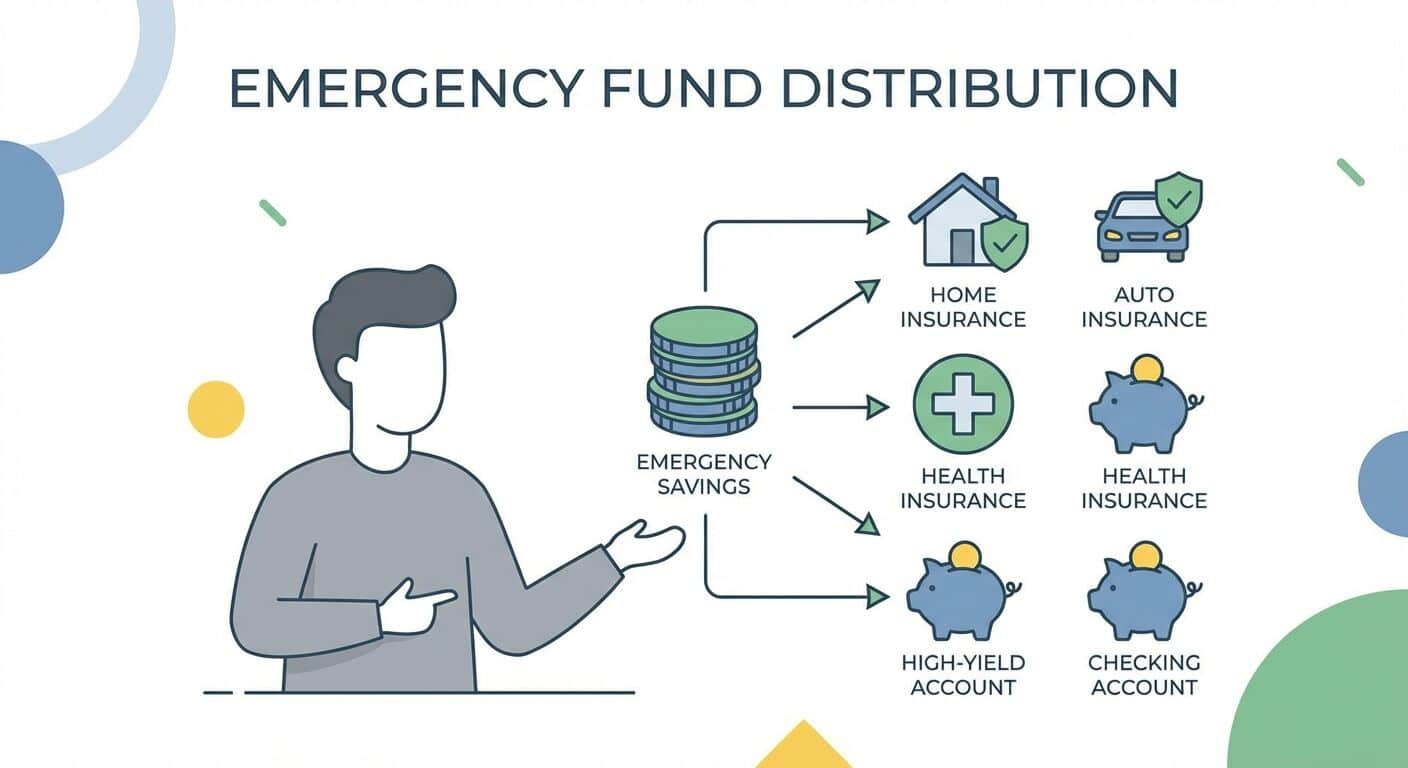
To keep a clear view, some choose to name their accounts in their banking area: “Safety cushion”, “Emergency fund”, “Projects”. This simple label helps avoid dipping into the wrong place, especially in periods when everything gets mixed up in the head.
Importance of regular monitoring and adjustment according to personal changes
Once the structure is in place, one often neglected step remains: monitoring. Emergency savings is not a block set once and for all. Expenses evolve, objectives too. A quick check once or twice a year is enough: recalculate essential charges, check the overall cushion level, and adjust if necessary.
Certain events are strong signals to revisit this point: birth, separation, moving, new job, significant rent increase. At each stage, the question to ask yourself is simple: “If my income suddenly drops tomorrow, how long can I hold on without panicking?”. The answer immediately indicates whether your level of emergency savings is adequate.
It’s also useful to watch where the limit lies between a useful reserve and money too dormant with very low return. Once the cushion is reached, keeping huge sums on a Livret A can slow down your long-term projects. Hence the interest of having a clear rule to transfer the surplus to other investment horizons.
When to transfer part of your emergency savings to long-term investments
The right time to move part of your emergency savings to long-term investments is when three conditions are met. First, the cushion properly covers 3 to 6 months of essential expenses. Second, there are no toxic debts to repay as a priority (expensive consumer loans, chronic overdrafts). Third, no major short-term need is looming (large unavoidable purchase, announced period of unemployment).
Once these conditions are met, the surplus can start feeding more dynamic vehicles: diversified ETFs, fractional real estate, SCPI, etc. Assurance vie is particularly convenient for this, thanks to internal arbitrages. You can for example keep part in euro funds for safety and move the surplus to growth-oriented supports for the long term, without immediate friction.
The central idea remains the same: never touch the heart of your emergency savings. This core must not depend on markets or value variations. It’s this respect for the boundary between safety and investment that allows you to build, stone by stone, a firmer and freer financial situation.
Emergency savings calculator
Calculate your ideal emergency savings in a few seconds by entering your essential monthly expenses and the number of months you want to cover (between 3 and 6). The result will give you the target amount and a suggested monthly savings to reach it.
Tip: with a stable situation, 3 to 4 months can be sufficient in most cases.
Profile | Monthly essential expenses | Savings target (months) | Emergency savings target amount |
|---|---|---|---|
Samir, single employee | 1 200 € | 3 to 4 months | 3 600 to 4 800 € |
Claire & Julien, couple with 2 children | 2 500 € | 4 to 6 months | 10 000 to 15 000 € |
Nadia, self-employed | 1 800 € | 6 months | 10 800 € |
Vehicle | Capital safety | Availability | Main objective |
|---|---|---|---|
Livret A | Total | Immediate | Base of emergency savings |
LDDS | Total | Immediate | Complement to Livret A |
LEP | Total | Immediate | Priority if eligible (better return) |
Fonds en euros of assurance vie | Very high | A few days | Second level of security, transition to long term |
Start by securing 1 month of expenses, then increase gradually.
Automate transfers to your savings accounts to make progress without thinking about it.
Reassess your savings level once or twice a year.
Why is the return on my emergency savings less important than its safety?
Because the main mission of emergency savings is to protect you, not to make you richer. It must be available in an emergency, without value variation or risk of loss. Return comes in third position, after safety and availability. Once your cushion is built, you can look for better returns on appropriate long-term vehicles.
Should I place all my emergency savings on a single Livret A?
No, you can split it. The Livret A has a ceiling and may not always cover the entirety of the ideal reserve. It’s often relevant to use a LDDS as well, or a LEP if you’re eligible, then a fonds en euros of assurance vie for the portion that doesn’t need to be available immediately.
How long does it take to build a proper emergency savings?
It depends on your situation and the targeted amount. The important thing is to start, even with small amounts. For example, by saving €100 per month, you reach €1,200 in a year, which already corresponds to one month of expenses for many households. What matters is regularity and progressively increasing the effort as your means allow.
Is it a good idea to invest my emergency savings in the stock market?
No. Stocks, ETFs, cryptocurrencies or other volatile vehicles are reserved for long-term savings. Your emergency savings must remain protected from market variations to be available in any context. Invest only the money that exceeds this cushion and that you can leave invested for several years.
What should I do if I need to use part of my emergency savings?
It’s normal to use it: that’s what it’s for. After the hardship, the goal becomes to rebuild it progressively. You can temporarily increase automatic transfers, reduce some non-essential expenses, or allocate part of a bonus or a tax refund to restore it.
Leave a Reply