
In short
Financial independence is not reserved for millionaires: it’s a gradual path made of several levels of peace of mind and freedom.
The basics: a safety cash reserve, a clear budget, proper protection and some automations to avoid everyday mistakes.
Next steps: grow your income (active and passive income), invest gradually in real estate, the stock market, ETFs or SCPI.
The core of the game: concrete goals, spending management aligned with your values, and a mindset built on patience and compound interest.
Duration matters more than speed: secure your wealth, adjust your protection, optimize taxes and stay motivated, even when life disrupts plans.
Taking control of your money is not about obsessing over every cent. It’s mainly about stopping to be passive. Financial independence is not a movie set with luxury cars and seaside villas. It’s the very real ability to say no to a job that destroys your health, to refuse an abusive landlord, or to take a few months to retrain without panicking about every bill. Behind this often caricatured concept there is a simple idea: build a margin so that money supports your choices instead of dictating them.
Many imagine they must already earn a lot to start, or master the stock market and real estate. The reality is less flashy, but more reassuring. By setting a few solid basics – a safety cash reserve, a readable budget, minimal protection of your assets – each progress becomes easier. Then come steps to diversify income, initial investments, learning mechanisms like compound interest. This guide follows that path in order, without magical shortcuts, but with concrete examples.
The goal is not to turn you into a trader, but to give you enough clarity and method to move forward, whatever your starting point. Maybe you want to prepare for retirement, secure your family, or simply no longer have that knot in your stomach at the end of the month. Whatever your age or current level, there is a logical progression, step by step, that respects your pace and constraints. This journey toward financial freedom looks more like a steady walk than a sprint: it’s your repeated decisions, even modest ones, that will make the difference.
Understanding financial independence: decoding and concrete realities
Financial independence: much more than a millionaire’s dream
When we hear about financial independence, we often imagine early retirees at 35, in the FIRE movement, or influencers promising a dream life in a few months. This image is misleading. In real life, this concept mainly means: having enough margin to not be trapped by money at the slightest unforeseen event. It’s being able to handle a car breakdown, a layoff, or a change of project without collapsing financially.
Financial independence is not an on/off switch. It’s a continuum, a progression with steps. At first, it’s simply getting out of survival mode by building a small cushion of savings and mastering your expenses. Then you strengthen your income, reduce your debt and start placing your capital in simple investments. Only later can you consider letting passive income take over. It’s a stone-by-stone construction, not a stroke of luck.
This path is neither reserved for high salaries nor limited to certain professions. I personally discovered these concepts after years in a warehouse, with irregular hours and a standard salary. What makes the difference is less the salary level than how you use it: life choices, budget management, refusing useless consumer loans, prioritizing goals. Understanding that is already regaining power.
Financial freedom: having the power to choose without constraint
Financial freedom is the human face of financial independence. It’s the ability to say: “I stay”, “I leave”, “I train”, without being completely captive of next month’s paycheck. For some, this freedom means reducing working hours to spend more time with their children. For others, it’s being able to refuse unpaid overtime, or to leave an overly expensive city for one better suited to their life goals.
Practically, this freedom often begins well before having massive passive income. It emerges as soon as an emergency fund is built, overdrafts are no longer a way of life, and the biggest sources of financial stress calm down. From there, you give yourself the right to make calmer choices: negotiate your salary, change positions, accept a training to evolve, start a small entrepreneurial project. Each step in that direction strengthens the sense of control.
It’s important to say it clearly: financial freedom is not a total escape from work. Many people who reach a high level of financial independence continue to work, but on their own terms. They choose missions aligned with their values, or accept earning a little less to gain in quality of life. The real victory is no longer being forced to remain in an imposed situation in order to pay the bills.
The different steps toward financial independence
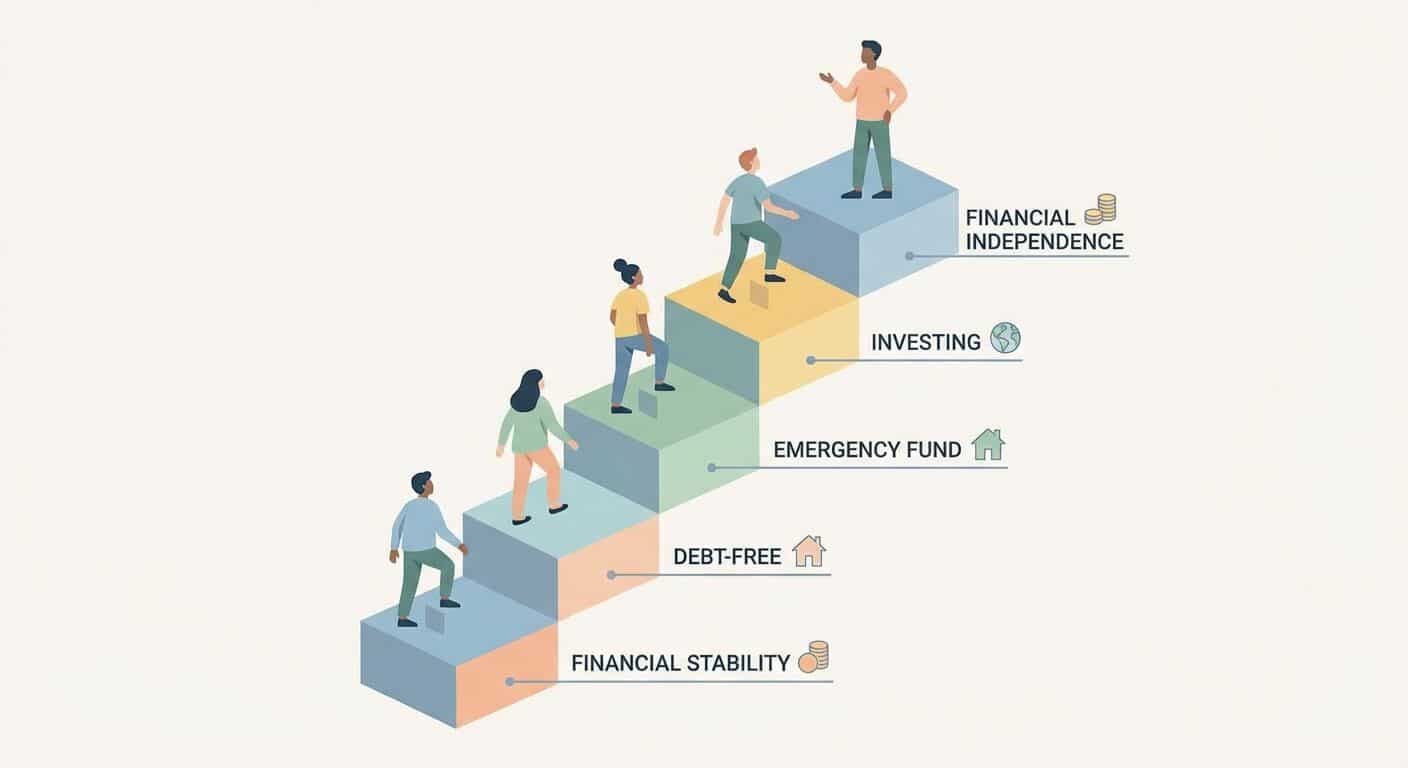
To make this concrete, we can view financial independence as a multi-rung ladder. The first is basic serenity: a safety savings that covers several months of essential expenses. We are not talking about big investments in the stock market or real estate, but an accessible cushion in case of hardship. At this stage, the main goal is simple: no longer falling into overdraft or loans with each unforeseen event.
The second level is everyday freedom. Income comfortably covers expenses, debt is under control, the budget is managed. You begin to invest regularly – for example through ETFs in a PEA or life insurance, or via small parts of SCPI. The third level is professional autonomy: a significant part of expenses is covered by passive income (rents, dividends, annuities), which allows you more freedom in choosing your job, hours, or even launching your activity.
Finally, the fourth level corresponds to total financial independence: recurring cash flows from investments (for example in rental real estate, SCPI or portfolios of ETFs) cover all needs. Work then becomes a choice, not a vital obligation. Not everyone wants or needs to reach this summit. The essential thing is to identify the rung that corresponds to your own financial goals and adapt your path accordingly.
Concrete examples: acting with serenity daily to conquer your freedom
To illustrate these steps, take Samir, 38, an employee in logistics. He starts with zero savings and a small car loan. For one year, he focuses on a single goal: build an emergency fund covering three months of expenses. He reviews some items in his budget (unused subscriptions, food, car insurance) and automates a monthly transfer to a savings account. By the end of the year, the cushion is there. He hasn’t changed his life, but he sleeps better.
The following year, Samir tackles investments. He opens a PEA, starts with a simple global ETF plan, without trying to “beat the market”. He deposits a fixed amount each month, even modest. Thanks to the first effects of compound interest, his capital begins to work in the background. At the same time, he researches rental real estate and later invests in a small parking space, a first concrete test of passive income. The rents are not huge, but they materialize a new source of income.
Years later, his success is not due to a gamble, but to that simple, repeated discipline. His story shows that financial independence is not a magical finish line. It’s a succession of small decisions consistent with your goals. The important thing is to make each daily choice a little more aligned with the life you want to build.
Breaking limiting myths to dare to aim for financial independence
Debunking the need for a high salary to progress
One of the most powerful barriers is the belief that you must already earn a lot to talk about financial independence. In reality, mastering cash flows often weighs more than the exact salary amount. Obviously, a comfortable income makes things easier, but it’s not the mandatory starting point. Many people with modest incomes manage to build a savings cushion and initial investments by simply structuring their spending management.
The key is to work on three levers in parallel. First, reduce invisible leaks (bank fees, subscriptions, extra insurance costs). Next, optimize constrained expenses: housing, transport, energy. Finally, look for realistic paths to progressively grow your income: better-paid overtime, changing company, upskilling through a training, small service projects. These combined adjustments often have more impact than a hypothetical spectacular raise that never comes.
By reasoning this way, financial independence becomes a credible horizon again. The idea is no longer to compete with executive salaries, but to make the best possible use of your current resources while gradually growing them.
Overcoming fear of risk and the myth of extreme sacrifice
Another common myth: to aim for financial independence, you must live like a monk, cut out all pleasures, refuse every outing. This extreme vision discourages in advance. It is also unnecessary. What matters is not eliminating every cafe on the terrace, but aligning your spending with your true goals. Many people spend thoughtlessly on things that do not make them happier, simply out of habit or social pressure.
Fear of risk also plays a role. The word investment scares because it is associated with loss. Yet, doing nothing also carries risks. Inflation erodes idle savings, missed opportunities represent an invisible cost. The point is not to bet everything on a single horse, but to practice intelligent diversification: some in real estate (direct rental or SCPI), some in ETFs, a bit of secure cash.
The right balance often lies in an approach where you keep an enjoyable life, but a more conscious one. You choose your pleasures, reduce the superflu, and put the gap toward your projects. Financial independence then becomes compatible with a meaningful present life.
Why it’s never too late to start your journey
Many tell themselves: “At my age, it’s too late.” This discourse traps you. Indeed, starting at 25 allows compound interest more time to act on capital. But starting at 40, 50, or later still changes the trajectory. Reducing debt, setting up correct protection, investing even modestly in ETFs or SCPI, can transform retirement or the end of a career.
Imagine Sophie, 52, starting over after a divorce. She might think there is nothing to do. Yet she starts by making a precise balance sheet, creating an emergency fund, then sets up a monthly payment into a life insurance invested mainly in ETFs. She simplifies her lifestyle, renegotiates some bank and insurance fees, and takes a short training that enables her to find a slightly better-paid job. Ten years later, without miracles but thanks to method, her situation is unrecognizable.
Financial independence does not mean the same at 25 as at 55. At 25, one often thinks of stopping work early. At 55, it’s more often about securing retirement and reducing dependence on uncertainties. In all cases, progress remains possible. The essential thing is not letting guilt or regret paralyze action.
Build solid foundations: savings, budget and financial protection
Create an emergency fund adapted to your personal situation
The first concrete pillar of financial independence is a safety savings. Without it, the slightest unforeseen event becomes an emergency. The idea is simple: gradually accumulate an amount that covers between three and six months of essential expenses (rent, food, transport, health). This is not a magic number, but a useful range to absorb a layoff, a major breakdown or a sick leave.
This fund must be both accessible and ring-fenced. Accessible because it must be used quickly in case of need. Ring-fenced because it must not be confused with a vacation reserve. A regulated savings account often does the job well. The aim here is not return, but safety and liquidity. Once this cushion is in place, mental pressure decreases and decisions about long-term investments (like the stock market or real estate) become calmer.
To build it, better target small regular deposits than a single sum hard to extract. Automating a monthly transfer, even modest, allows you to progress without thinking. This savings is not a luxury; it’s an essential shock absorber on the road to financial independence.
Simplified budgeting aligned with your values
The word budget evokes complex Excel sheets. Yet, a simple system suffices for most situations. The central idea is knowing where the money goes, and ensuring it reflects your priorities. You can for example divide expenses into three blocks: fixed charges (housing, energy, insurance), variable expenses (groceries, leisure, transport), and goals (savings, investment, projects). From there, check that the share devoted to financial goals gradually increases.
An effective budget is not punishment. It’s a dashboard. It allows you to decide consciously: do I prefer to keep that unused subscription, or turn it into strengthening my emergency fund? Does this purchase meet a real need or simply fill a temporary fatigue? The more these questions become natural, the more progression toward financial independence happens without forced effort.
To track this budget, some prefer a simple notebook, others a banking app categorizing expenses. The tool matters less than regularity. A few minutes a week are enough to keep control, adjust, and spot where to act first.
Automate your finances to gain serenity and consistency
Many financial failures come not from lack of will, but from too much daily friction. Each time you must remember to make a transfer, the mind finds a good excuse to postpone it. Automation then becomes a major ally. It’s about organizing cash flows so that most important movements happen without manual intervention.
You can, for example, schedule transfers at the start of the month to the emergency fund, investment pockets (ETF plans, life insurance deposits, SCPI investments) and project accounts. The idea is simple: pay your goals first, then live on what remains, rather than the opposite. This subtle reversal strongly accelerates progress toward financial independence, because it limits impulsive decisions.
Optimize your bank accounts and automatic transfers
For automation to work, account structure must be clear. Many gain simplicity by using multiple accounts: a main account to receive income, an account for “fixed charges”, a “fun” account and a “projects” account. As soon as the salary arrives, automatic transfers distribute money according to these envelopes.
This system has two advantages. First, it reduces errors: important payments are secured. Second, it makes visible what is actually available for leisure, without touching savings or investments. You can thus spend your fun budget without guilt. At the same time, it’s useful to monitor bank fees: unused cards, costly overdrafts, various commissions. Every euro saved there strengthens your margin of maneuver.
Protect your assets with targeted insurance
Building your wealth without protecting it is like building a house without a roof. Financial protection involves a few well-chosen insurances, not accumulating useless contracts. Priorities vary according to situations: liability insurance, complementary health insurance, income protection in case of work stoppage, life insurance to protect loved ones, loan guarantee for a real estate mortgage. The idea is to cover major risks that could jeopardize years of effort.
It’s not about over-insuring everything, but asking a few simple questions: if I fall ill for several months, who pays the rent? If I die, can my loved ones keep the home? If my professional activity stops, do I have minimum protection? Answering these questions helps choose the right contracts, remove others, and optimize fees. This protection is a discreet pillar of financial independence: it prevents a single hardship from wiping out the progress made.
Diversify your income sources for reinforced stability
Identify and develop your active and passive income
Once the basics are set, the logical next step is to work on income. We generally distinguish two main categories. Active income depends directly on your time and work (salary, gigs, services). Passive income, on the other hand, continues to come in even when you are not working directly: rents from real estate, dividends, interest from investments, SCPI shares, royalties, etc.
At first, almost all resources come from active income. The goal is not to disdain them, but to optimize them: ask for a reasoned raise, change company, train for better-paid skills, accept certain well-paid short projects. At the same time, begin to convert part of that flow into productive capital generating passive income. The larger this second flow grows, the less dependent you become on direct work.
This dynamic is at the heart of financial independence. The goal is not to flee work at all costs, but to balance the scale. In the long run, assets (properties, investments, business shares) work for you, not the other way around.
Appropriate investments: real estate, stock market and entrepreneurship
To build these passive income streams, several major families of investment exist. Real estate rental is one, with different forms: standard apartment, shared housing, seasonal rental, parking, or SCPI which let you invest in property without managing tenants yourself. Each option has its strengths, constraints, risks and return perspectives. For example, a small parking space requires less management than an entire building, but also generates more modest income.
For real estate, if you don’t have borrowing capacity, solutions like tokenized real estate with RealT are options
The stock market is another major route. Rather than playing traders, many individuals today choose diversified ETFs, which group hundreds of companies in a single product. This provides access to global markets with risk reduced by diversification, and often low fees. Dividends paid by some companies feed your passive income, while the share value can grow, generating potential capital gains over the long term.
Entrepreneurship completes this picture. Creating a small online business, offering consulting, selling digital products are ways to turn skills into new sources of income. This type of project requires time at first, but can later be partially automated. The important thing is to choose formats you understand, aligned with your values, and compatible with your family and professional constraints.
Adopt a progressive strategy that respects your values
Faced with this variety of possibilities, it can be tempting to scatter your efforts. However, progress toward financial independence relies more on a clear, progressive strategy. Better to start simple: an automated savings plan into one or two ETFs, then a first modest real estate investment, possibly via SCPI if you don’t want to manage tenants. As you gain confidence and experience, you can add other bricks.
Respecting your values is essential. Some will favor tangible real estate because they like physical properties. Others will prefer financial markets, more flexible. Others still will align their investments with ethical criteria. In any case, coherence with your goals and way of living matters more than chasing the highest theoretical return.
The aim is not to follow trends or a neighbor’s advice, but to build a financial architecture that fits. This coherence makes the approach sustainable, avoiding sudden reversals driven by fear or momentary enthusiasm.
Calculateur d’indépendance et de liberté financière
Estimez le temps nécessaire pour atteindre votre objectif d’indépendance financière en fonction de votre capital, de votre épargne, du rendement et de vos dépenses annuelles à couvrir.
Somme déjà investie ou disponible pour être investie.
Montant que vous pouvez investir chaque mois de façon régulière.
Rendement annuel net supposé (après frais et impôts sur les revenus).
Montant annuel de vie souhaité (logement, alimentation, loisirs, etc.).
Options avancées (taux de retrait & prise en compte de l’inflation)
Pourcentage du capital que vous retirez chaque année (la “règle des 4 %” est une référence courante).
Sert uniquement à ajuster vos dépenses annuelles en euros d’aujourd’hui.
This tool provides an educational estimate, based on simplified assumptions. It does not constitute personalized financial advice.
Develop your financial intelligence and cultivate a winning mindset
Transform your relationship with money for more freedom
Financial independence is not decided by numbers alone. It also depends on the relationship you have with money. Many people grew up with contradictory messages: “money doesn’t buy happiness”, “you should enjoy life while you can”, “rich people are necessarily dishonest”. These beliefs quietly influence daily decisions. They can lead to sabotaging your own efforts, feeling guilty when you want to increase your income, or avoiding talking about your financial goals.
Transforming that relationship requires honest work with yourself. What does money represent for you today? Security, recognition, freedom, stress? Asking these questions helps understand why certain decisions repeat, like draining your account at the end of the month. By clearly defining what financial independence would mean for you (free time, security for children, retirement planning), money becomes a tool rather than a taboo.
Accepting ambitious goals is not shameful. It doesn’t prevent solidarity or respecting your values. On the contrary, a stabilized situation gives more capacity to help and take initiative.
Continuous learning and community support to progress
No one is born with a personal finance manual in hand. Financial intelligence develops. An academic education is not essential to understand savings, investments, the stock market or real estate. What matters is exposing yourself regularly to educational content suited to your level and putting it into practice.
Books, blogs, videos, podcasts: resources abound. The important thing is to remain critical, avoid promises that sound too good and “miracle systems”. A good test is whether the content helps clarify your goals, understand the risks and take concrete action. Surrounding yourself with a community – forums, exchange groups, friends with similar concerns – also helps keep the distance. You find experience feedback, encouragement and new ideas there.
Even a modest network breaks isolation. It reminds you that aiming for financial independence is not eccentric, but a logical way to regain control of your life.
Manage financial emotions: resilience and long-term vision
Money rarely gets along with strong emotions. On a chart, investing in ETFs or real estate seems easy: the curve rises over the long term. In reality, there are periods of decline, doubt and questioning. That’s where many give up, sell at the worst moment or stop regular contributions. Managing these phases is a key element of financial independence.
The first step is to accept these variations as normal. A temporary drop in portfolio value is not a doom, especially if the target horizon is long (retirement, time freedom). The second step is to equip yourself: reread your investment plan, remind yourself why you chose specific assets, check that fundamentals haven’t changed. The third step is to stay connected with people who share a long-term vision, so you don’t succumb to collective panic.
Financial resilience builds like a muscle. Each difficult period navigated without quitting strengthens confidence in your ability to stick to a plan. Over time, this emotional stability matters as much as technical choices on the road to financial independence.
Maintain motivation with concrete, realistic goals
A vague project like “become rich” doesn’t motivate long. In contrast, precise, dated and measurable goals energize. For example: “Save €3,000 in emergency savings in 18 months”, “Deposit €200 per month into a PEA invested in a global ETF”, “Purchase a first SCPI share within two years”. These targets allow you to track progress, however modest, and celebrate milestones.
The SMART method (Specific, Measurable, Achievable, Realistic, Time-bound) helps structure these goals. It forces you to ask: does this target match my current situation? Is it compatible with other commitments (family, work, health)? Better a modest goal sustained over years than an unrealistic ambition abandoned after three months. Regularity, supported by automations and compound interest, then does the background work.
Each goal achieved, however small, reinforces the feeling of truly moving toward financial independence. This accumulation of victories quietly changes your outlook on the future.
Take action: practical advice to start your financial journey
Honestly assess your current financial situation
Before aiming for financial independence, you need to know where you start. This inventory can be scary, but it’s essential. It’s about listing your income (salaries, benefits, pensions, possible rents), fixed charges (rent, loans, subscriptions, insurance), average variable expenses, debts and your current savings level. You then get a clear snapshot of the situation.
For many, this step reveals surprises: forgotten fees, an expensive consumer loan, a small inheritance left in an unproductive account. The idea is not to judge yourself, but to see margins of maneuver. This diagnosis then helps set priorities: reduce commitments, renegotiate contracts, or concentrate efforts on building a basic savings.
This honesty with yourself is the first act of regaining control. Without it, any investment or optimization effort remains fragile.
Use simple tools to track and manage your budget
Once the starting point is set, the budget tracking tool becomes a daily ally. No need for perfection. A simple file, a banking app or a printed sheet can suffice. The principle is to note, for a few months at least, the essential inflows and outflows. This helps spot trends: rising transport costs, explosion of small online purchases, gradual drop in charges after renegotiation.
Some like to categorize in detail, others prefer broad blocks. The important thing is to choose a system you can maintain, not one you abandon after two weeks. This tracking quickly becomes liberating: it removes uncertainty, allows adjusting your goals, and informs investment decisions. Instead of hoping to save “what’s left”, you know precisely how much can be directed toward savings and passive income.
Draw up a personalized and flexible action plan
From this diagnosis and tracking, it’s time to build a plan. Not a fixed document, but a flexible roadmap. You can break it into three horizons. Short term (6 to 12 months) focuses on security: creating the emergency fund, stabilizing overdrafts, reducing consumer loans. Medium term (1 to 5 years) scales up investments: first ETFs, possible entry into real estate, participating in SCPI, launching a small revenue-generating project.
Long term, goals become clearer: share of expenses covered by passive income, desired age to reduce work time, target capital amount. This plan should remain flexible because life isn’t a straight line. Birth, illness, move, job opportunity: each event may justify an adjustment. The essential thing is to keep the general course toward financial independence while accepting necessary detours.
Key first steps to build your independence
To summarize these first steps, see them as a logical sequence. First, face reality with an honest diagnosis. Next, secure daily life by building the emergency savings. Then, take back control of debt and unnecessary fees. Finally, launch the first regular investment flows, even modest, into simple and diversified vehicles.
Here is a concrete way to start:
Open a dedicated savings account for security and set up an automatic fixed deposit each month.
Set up an automatic deposit into a PEA or life insurance invested in diversified ETFs.
Choose a first small real estate project (parking, SCPI, shared housing with a relative) to test generating passive income.
Each of these steps, even if modest, concretely moves you away from total dependence on the next paycheck. Financial independence is built this way: one decision after another, in a coherent order.

Protect and optimize your financial independence over the long term
Role of taxation and wealth management
As your wealth grows, a new issue arises: taxation. It should not be seen as an enemy, but as a factor to integrate. The same investment can have very different impacts depending on the vehicle used (PEA, life insurance, brokerage account for the stock market, direct holding or SCPI for real estate). Understanding the main lines helps avoid costly mistakes and optimize the gain/tax ratio.
For example, placing ETF equities in a PEA can be advantageous after a few years thanks to a beneficial long-term tax framework. Similarly, some types of real estate (like furnished rental) benefit from specific regimes. Wealth management then involves structuring your assets: what percentage in cash, in the stock market, in physical properties, in SCPI, in entrepreneurial projects. This architecture directly impacts the stability of your income and the durability of your financial independence.
If your situation becomes complex, the occasional support of a competent and independent professional can be relevant. The goal is not to delegate blindly, but to make informed decisions.
Adapt your protection as life and goals evolve
The financial protection mentioned earlier is not fixed. It must evolve along with your life and goals. Birth of a child, buying a real estate property, change in professional status, expatriation: each step modifies needs in insurance, income protection, legal coverage. Reviewing your situation regularly, for example every two or three years, allows adjusting contracts, removing some and strengthening others.
In the long term, the question of transfer also becomes important. How to organize your wealth to protect a spouse, children, or a vulnerable person? Should you consider life insurance, a gift, a specific clause for SCPI shares or a property? These topics may seem distant, but they contribute to the robustness of your financial independence. A poorly thought-out structure can create blockages or family conflicts, whereas a well-planned arrangement facilitates the future.
The essential thing is to keep in mind that financial freedom is not limited to your daily life. It also concerns the ability to preserve and pass on what you have built, without letting chance or urgency decide for you.
Adopt a benevolent and progressive approach to financial freedom
Pragmatism and perseverance: keys to lasting success
Observing those who truly progress toward financial independence, we rarely find magical recipes. We mostly find pragmatism and perseverance. Pragmatic because decisions are made according to the person's reality, not an ideal model. Persevering because actions are repeated, even when motivation fades, markets decline or life complicates plans.
Pragmatism means accepting that you cannot optimize everything at once. Start where impact is greatest: renegotiate a loan, reduce fees, create an emergency savings, set up a small automatic investment plan. Perseverance is continuing these actions month after month, without questioning everything at the slightest difficulty. Over five, ten or fifteen years, this consistency makes an enormous difference to your capital, income and quality of life.
At heart, financial independence is less about talent than about habits. These realistic, sustainable habits are what truly change the trajectory.
Balance technical advice and motivational support
Numbers and tools are important, but not enough. Those who go the farthest combine two dimensions: solid technical decisions (choice of investment, budget structure, diversification of income) and an environment that supports motivation. This balance helps you hold on when initial enthusiasm fades.
Practically, this can be achieved through simple habits:
Practice | Impact on finances | Impact on mindset |
|---|---|---|
Monthly review of the plan and goals | Adjust savings and investments | Recall progress made |
Automation of transfers and payments | Secure flows of capital and income | Reduce mental load |
Read or consume financial content once a week | Improve investment choices | Maintain motivation |
Regular exchanges with a person or group | Discover new passive income ideas | Feel supported and less isolated |
This mix of technique and human support provides a solid base. It avoids falling either into pure emotion (following the latest fad) or pure theory (never taking action). On this basis, financial freedom stops being an abstract idea and becomes a structured life project, adapted to your reality, pace and priorities.
Level of freedom | Description | Examples of levers |
|---|---|---|
Level 1 – Serenity | Emergency fund, end of chronic overdrafts | Automatic savings, fee reduction, budget tracking |
Level 2 – Calm everyday life | Income comfortably covering charges, start of investing | ETF plan, first SCPI shares, small side activity |
Level 3 – Professional autonomy | Significant part of expenses covered by passive income | Real estate rentals, stock portfolio, entrepreneurship |
Level 4 – Total independence | Work by choice, wealth covering essential needs | Capital diversified, tax and wealth optimization |
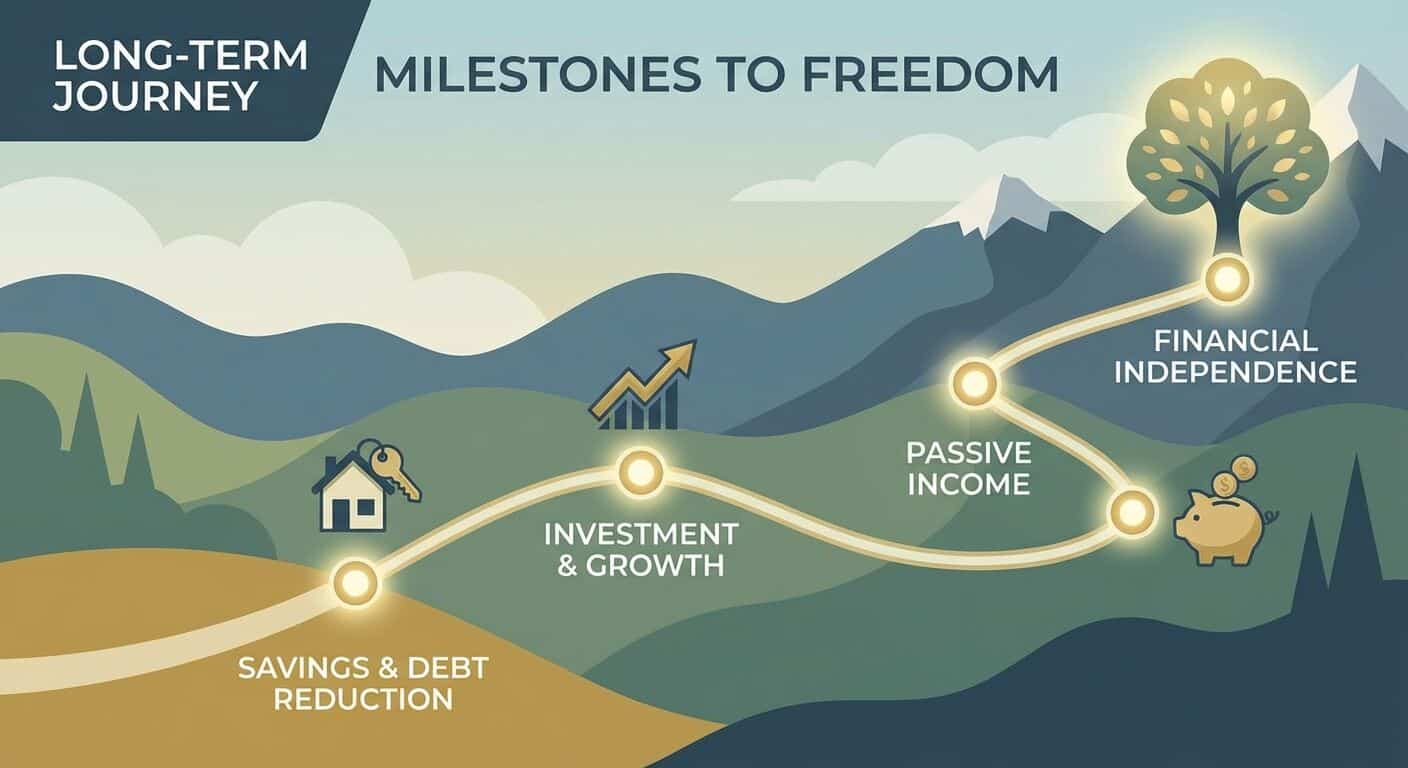
By moving from one level to the next, respecting your reality and building simple habits, you gradually create your own version of financial independence. This path belongs to no one but you.
Should I pay off all my debts before starting to invest?
Not necessarily. It depends on the type of debt and the rates. High-cost consumer loans should be prioritized because they strongly hinder progress toward financial independence. Conversely, a mortgage at a reasonable rate can coexist with investments, especially if those investments are regular, diversified (for example via ETFs or SCPIs) and consistent with your goals. The important thing is to keep a global view: reduce the weight of debts while starting to build passive income and productive capital.
Where should I start if I have no savings?
The first step is to secure the emergency: create a small safety fund, even a few hundred euros at the start. You can do this by cutting easy-to-remove expenses (subscriptions, overpriced insurance), then setting up an automatic transfer, even small, to a savings account. Once this base cushion is built, you can gradually aim for 3 to 6 months of expenses while beginning small, simple and regular investments. The essential thing is to start, even with little.
Are ETFs suitable for beginners?
Yes, provided you understand the basics. ETFs are funds that replicate an index and offer wide diversification with often low fees. For a beginner, choosing one or two global ETFs via a PEA or life insurance can form a good long-term investment base. However, you must accept market fluctuations, invest only money you do not need in the short term, and stay regular in your contributions to benefit from compound interest.
Can I achieve financial independence only with real estate?
It is possible to build a large part of your financial freedom with real estate: classic rentals, shared housing, seasonal rental, SCPI, etc. However, relying solely on one asset type increases certain risks (vacancy, tax changes, geographic concentration). Minimal diversification, for example adding a stock portfolio via ETFs and some cash, strengthens overall stability. The important thing is to choose a strategy you understand and can manage over time.
How long does it take to become financially independent?
There is no universal duration. It depends on your starting point, income, savings capacity, investment choices, age and level of independence sought. For some, reaching an initial level of serenity can take 1 to 3 years. Building real passive income sufficient to live on may take 10, 15 or 20 years. The important thing is less speed than direction: each year following a clear plan, with consistent decisions, brings you closer to your goals and improves your margin of maneuver.
Leave a Reply