🚨 RealT Update: Sale of Real Estate… Why it’s (ultimately) the Best Way Out
You probably received their latest email announcing a phase of “strategic repositioning.” In short: the platform is preparing to put a large portion of its property portfolio up for sale, submitting these sales to a vote by token holders.
At first glance, with the recent rent suspensions, this looks like very bad news. Yet, with some perspective, this resale is probably the most reasonable decision today to protect our investments. Here is my analysis of the situation.
The domino effect: how did we get here? To understand this situation, you have to look at the chain reaction that hit the RealT ecosystem in recent months:
- The Detroit abyss: The legal showdown with the city of Detroit has led to rents being held in escrow for over 7 months for a large majority of the portfolio. During this time, RealT saw its cashflow heavily drained by token buybacks, renovations and legal fees.
- Panic and the RMM freeze: Faced with these uncertainties and the suspension of rents, a fear movement (entirely understandable among investors) caused capital outflows. Result: the RMM (liquidity system) became completely frozen.
- The secondary market at a standstill: With a tense ecosystem, the YAM (secondary market) is now “Out”, making peer-to-peer token resale almost impossible.
The exit strategy: sell to get out of the deadlock Today, RealT’s announced goal is to renovate, stage (showcase) and professionally market the houses to resell them on the traditional real estate market. In short, RealT is preparing a controlled exit from the ecosystem.
My point of view: why this is the most reasonable choice I’m the first to be frustrated by how events have unfolded, but faced with this deadlock, I support the initiative to resell the properties.
- A clean exit is better than a crash: Any managed and controlled exit from the ecosystem is preferable. The alternative, with an empty cashbox, would have been much worse.
- The hope of a capital gain: Let’s not forget that the properties will be sold on the real market. Even if nothing is guaranteed, it is highly likely that some properties will be sold at a capital gain compared to our initial purchase price.
- A potentially positive overall balance: Between the rents we’ve already collected so far and the recovery of our capital (or even the capital gain) when sold, the overall operation could still remain in the black.
What to do now: In the coming days and weeks, RealT will ask us to vote on the sale of several lots (in Detroit, Chicago, etc.). I strongly encourage you to participate in these votes. If the buyout offers match market expectations, it’s an opportunity to liquidate our positions cleanly.
The situation requires patience, but the value of our real estate assets is still there, in bricks and mortar. It’s now a matter of unlocking it
🚨 RealT Alert: Why I’m Pausing My Recommendations (Important Update)
Out of complete transparency with you, I must give an urgent update on RealT’s current situation. As you know, I previously recommended their services via my affiliate link, advising certain investment strategies notably favoring properties outside Detroit.
However, the situation has drastically changed in recent weeks.
What is happening right now Several warning signs are lighting up simultaneously and force me to reconsider my position:
- Suspension of rents: The distribution of rental income is currently on hold. This is the heart of the model that is affected.
- Legal conflict in Detroit: The standoff with the city of Detroit is dragging on. The trial, which was supposed to clarify the situation, has been postponed to May. This extends the uncertainty over a large portion of the property portfolio.
- RMM freeze: The liquidity system (RMM) is completely blocked, preventing fund movements and the flexible management of your assets as before.
My opinion and recommendations Until now, one could think that only certain properties in Detroit were affected. Today, with the cashflow problems and the RMM freeze, the entire ecosystem is weakened.
Consequently:
- I no longer recommend investing new funds on the platform for the moment.
- If you were planning to buy tokens (even outside Detroit), I advise extreme caution and to wait.
- We must wait for the legal deadline in May to see whether the company manages to turn things around or if the situation worsens (“things smell bad”, to speak frankly).
I will continue to monitor the matter closely. My role is to share good deals with you, but also to alert you when the wind changes. For now, caution is the best policy: keep your cash.
I will update this article as soon as we have concrete news about the resumption (or not) of payments.
Key takeaways
- ✅ It’s tangible: Rents paid every week, not virtual speculation.
- ✅ It’s accessible: $50 to get started.
- ❌ It’s not without risk: The Detroit crisis and falling yields prove that real estate remains a living market. You must diversify.
I’ve been investing on the RealT platform since May 2023. If you’re looking for an on-the-ground opinion, away from marketing promises, you’re in the right place.
The combination of Web3 and real estate may seem technical. Yet, RealT succeeded in making it simple with its “Walletless” mode which evolved into the RealToken Wallet. Concretely, the platform modernizes wealth management by borrowing the principle of investment funds (REITs) and applying it to tokenized real estate. The result? A powerful tool to reach financial independence thanks to compound interest and passive income.
Result? A passive income accessible to everyone, from $50, without traditional banking barriers.
To date, I use no complex features, yet I’ve invested nearly $10,000 (the site’s primary currency) counting reinvested rents. Here is my full feedback on this leader in fractional real estate.
My view on RealT in brief (2026 summary)
My investor profile: 71 properties owned | ~ $10,000 invested | Strategy: Passive income.
If I had to summarize my experience in a few points to help you decide:
| ✅ Real Strengths | ⚠️ Watchpoints |
| ✅ Weekly Income: Rents hit every Monday (USDC). It’s addictive and tangible. | ⚠️ The Detroit Crisis: Rents blocked on some specific properties (municipal dispute). |
| ✅ Accessibility: Entry ticket at $50. Ideal for gradual diversification. | ⚠️ Declining Yields: We moved from 11-12% to 8-9% on new properties. |
| ✅ Liquidity: Resale possible via YAM or buyback by the platform (3% fee). | ⚠️ Currency risk: You invest in Dollars ($). EUR/USD affects your income. |
Secure registration on the official site RealT.co
My view on RealT at the start of 2026 is positive, but with clear reservations.
I’ve built a fractional real estate portfolio made up of 71 positions. Several of my shares are already in capital gains thanks to the rise of real estate in the United States. The platform has evolved by offering new diversification products:
- Pre-construction real estate;
- Factoring;
- Debt with collateral.
Last year was complicated, marked by a volatile global economy and the influence of Donald Trump’s tweets. In France, political instability shook the markets. In this context, owning real estate in the United States proved very comforting (a safe haven), offering greater stability compared to the turbulence of the French PEA.
⚠️ Watchpoint: The Detroit crisis
Let’s be transparent: RealT is going through a turbulent zone. A dispute with the municipality of Detroit led to rents being blocked for properties located in that city. Team errors and a certain naivety towards the local administration had consequences.
However, the founders’ response (the Jacobson brothers) strengthens my confidence: they covered the first lost rents with their personal funds. If the rents from this dispute are probably lost, the crisis management shows that the team is solid. For now, I continue to invest favoring other cities (Cleveland, Panama).
RealT, what is it? Understanding fractional real estate

From the classic investment fund to Tokenization
The concept of owning a fraction of a building is not new. For decades, Real Estate Investment Trusts (or REITs) have allowed individuals to buy shares of a property portfolio managed by professionals.
However, this traditional (“legacy”) model now suffers from frictions incompatible with the modern world: high management fees, entry tickets often reserved for large capital, and above all very low liquidity (getting your money back can take months).
This is where RealT changes the game using Blockchain. By replacing old paper ledgers with tamper-proof digital ledgers, RealT removes costly intermediaries. The result?
- Accessibility: You can invest from $50 (versus thousands for a classic fund).
- Speed: Transactions are done in a few clicks.
- Transparency: Each “Token” (digital token) represents a real share in the company that owns the property.
Is it reliable? The team and the legal structure
This is investors’ number one question (and it was mine). Is RealT a scam or a serious company?
Who are the founders?
RealT was founded by the brothers Jean-Marc and Rémy Jacobson. They are not crypto newcomers, but veterans of the American real estate market. They have been investing for over 30 years. Their strength? Having anticipated Detroit’s recovery well before others.
The legal setup: LLC and Inc
Unlike vague crypto projects, RealT is based on solid American law.
- Encapsulation: Each house is owned by its own company (LLC – Limited Liability Company). If one house has a problem (fire, lawsuit), it does not impact the other houses.
- The Token: The token you buy is not a volatile cryptocurrency, it’s a social share of that company. Legally, you are a co-owner of the company that holds the property.
This setup offers legal security far superior to classic real estate crowdfunding.
How to invest on RealT: Practical Guide

One of RealT’s strengths is having built a bridge between two worlds: traditional finance and cryptocurrency. Whether you’re a novice or an expert, there’s an entry point for you.
1. The Revolution of the “Realtoken Wallet”
One of RealT’s strengths is that it has been able to evolve. Forget the old “Walletless vs Metamask” debate. Since the end of 2024, RealT introduced a major innovation based on Account Abstraction: the Realtoken Wallet.
What is it? (The best of both worlds) It’s a real crypto wallet (on the Gnosis Blockchain), but used with the simplicity of a classic banking app.
- Easy login (Social Login): No need to write down a 24-word seed phrase on paper. You log in with your Google, Facebook, Discord or Twitch account.
- Advanced features: Unlike the old passive “Walletless” mode, this new wallet allows you to interact with the DeFi ecosystem (YAM, RMM).
How does it work in practice?
- You create your account on RealT.co via your Social Login.
- An “Abstract Account” (your digital safe) is created automatically on the Blockchain.
- You buy your shares by Credit Card.
- You manage everything via: wallet.realtoken.network.
My advice: This is now the default method I recommend 100% to new entrants. It combines blockchain security and Web2 UX (user experience).
To go further the RealT Community Wiki is a treasure trove of knowledge and explanation.
To be totally transparent with you, the method I personally used for 2 years is the old Walletless version. I favored simplicity to secure my $10,000 invested. However, I plan to switch soon to the abstract account to unlock the advanced features (DeFi) described below.
⚠️ Warning: The golden rules of the Realtoken Wallet Even if it’s simple, it’s still crypto. Here are the traps to avoid with this new system (based on my analysis of the technical documentation):
- Gnosis network only: This wallet lives only on the Gnosis Chain. Never send Ethereum or Bitcoin directly to it, they would be lost.
- Be patient with transactions: The web app acts like a remote control. Sometimes transactions via WalletConnect require juggling between two windows. Take your time, don’t click ten times.
2. The Expert method: The Gnosis Blockchain
For more advanced investors (or those who want to learn), RealT operates on the Gnosis Chain. Why this choice?
- Tiny fees: A transaction costs less than $0.01.
- Speed: Exchanges are quasi-instantaneous.
- Real ownership: You hold your tokens on your own key (Self-custody).
💡 My tip: Even if you start with “Realtoken Wallet“, I recommend that you eventually create your own wallet. RealT acts as an ideal bridge to the crypto world. The Realtoken Wallet simplifies access, but then switching to a personal wallet will allow you to replicate this know-how on other investments. It’s a perfect first step to train yourself before exploring the vastness of Web3 on your own.
Property management: 100% Passive
Once the Token is purchased, your work stops there. RealT delegates property management to local specialized companies (Property Managers, except in Detroit where they take over with their own management company). They handle finding tenants, collecting rents and managing repairs. On your side, you receive your share of net rent (after charges) every Monday. It’s a Swiss clock. Rents are paid in USDC (a stablecoin pegged to the Dollar), which you can reinvest or transfer to your bank account.
2026 catalog analysis: Yields and Quality
Unlike classic funds (REITs) where you buy a blind “basket”, RealT lets you pick your market (“Cherry Picking”). You choose precisely which building you invest in. But beware, the reality of the numbers has changed.
1. The reality of Cash-flow in 2026 (Why is it falling?)
This is where many opinions are outdated. At my beginnings, you could find nominal yields of 11% or 12% on Detroit. Today, the distribution rate is rather between 7.7% and 9%.
Why this drop? It’s not an arbitrary decision, but the mechanical consequence of market evolution and the catalog:
- The explosion of prices in Detroit: This is the main reason. Property prices rose following the city’s economic recovery. Mathematically, when a house’s purchase price increases while rents rise less quickly, the rental yield (percentage) falls. It’s a sign that the initial bet on the city’s recovery paid off: your tokens gain value, but the yield at purchase “normalizes”.
- The arrival of Chicago and “Multi-Family”: In its new expansion areas, notably Chicago, RealT offers more income buildings (Multi-Family), unlike Detroit’s single-family homes.
- The advantage: If a tenant leaves in a 6-apartment building, the other 5 continue paying. The risk of total vacancy disappears.
- The trade-off: These more resilient buildings in more mature markets naturally offer slightly lower yields than Single Family Homes in developing neighborhoods.
My conclusion: I now prefer to earn a calm 8% on assets whose value is rising or whose tenant risk is diluted (Multi-Family), rather than aiming for a theoretical 12% in an overly volatile area.

2. Internationalization and diversification
Since 2024, the catalog has expanded to reduce geographic risk (not putting everything in the same place in the USA). You can now find:
- Panama: High-end properties, often by the sea.
- Vacation real estate: Properties like Airbnb, offering seasonal yields.
- Debt products: You are not financing the purchase of the property, but a loan secured by real estate. The risk is different and often more secure.
And Europe? It’s the question everyone asks: when will there be properties in Spain or Germany? RealT has received and studied many proposals on the old continent. However, prudence remains the watchword. Legal obstacles regarding the “tokenization” of a company remain complex in Europe. For now, investing in European real estate is not planned in the short term, the team preferring to take no legal risk.
The upcoming surprise: The Middle East If Europe drags its feet, another geographic area could arrive very quickly in the catalog: the Middle East. This region is currently very favorable to tokenization and digital assets. Proposals are under review and it is highly likely that new properties located in this area will be offered soon.
3. The power of compound interest
This is the secret of my performance. With rents paid every week (and not quarterly), you can reinvest your gains immediately. Mathematically, an annual return of 8-9%, if compounded weekly, ends up far exceeding the displayed performance thanks to the snowball effect.
But this mechanism is further amplified by another factor: rising rents relative to your entry price. This is called “Yield on Cost”.
To illustrate this, here is a comparison on a selection of RealT properties, between the yield announced at the initial sale and the actual yield they generate today
| Property | Initial Yield (at purchase) | Current Yield (on purchase price) |
| 19539 Hickory | 10.08% | 17.41% |
| 19136 Tracey | 11.00% | 14.75% |
| 10974 Worden | 11.54% | 12.28% |
| 10862 Marne | 10.26% | 12.08% |
| 18624 Hamburg | 9.01% | 11.35% |
| 14574 Strathmoor | 9.58% | 10.62% |
| 18286 Oakfield | 9.24% | 10.18% |
| 11093 Nashville | 9.12% | 8.60% |
(Note: The “Current Yield” column corresponds to today’s net rent divided by the initial listing price).
What does this table teach us? It shows that the yield displayed on the day of purchase is not fixed.
- Look at Hickory: sold with an expected yield of 10%, it now delivers more than 17% per year to those who bought it at launch.
- That’s the magic of well-managed tokenized real estate: your purchase price remains fixed in the past, but rents can increase, mechanically boosting your profitability year after year.
4. The cherry on top: Revaluation (Capital Gain)
We talk a lot about weekly rents, but we often forget the second wealth engine: the property’s appreciation.
Once a year, RealT has its properties appraised by an independent firm.
- If property values have risen in the neighborhood, the house’s value is updated.
- Mechanically, the price of your Token increases.
Instead of giving a theoretical example, here is the actual data on a selection of properties. This table compares the total acquisition cost (including fees) to the new current appraised value.
| Property | Year of purchase | Acquisition Cost | New Net Value | Unrealized Gain |
| 19136 Tracey | 2021 | $61,260 | $98,554 | 60.88% |
| 19539 Hickory | 2022 | $60,768 | $95,879 | 57.78% |
| 11093 Nashville | 2024 | $77,617 | $103,899 | 33.86% |
| 10862 Marne | 2023 | $70,406 | $91,804 | 30.39% |
| 18624 Hamburg | 2024 | $78,461 | $102,233 | 30.30% |
| 10974 Worden | 2020 | $69,667 | $82,972 | 19.10% |
| 18286 Oakfield | 2023 | $59,964 | $61,900 | 3.23% |
| 14574 Strathmoor | 2024 | $93,573 | $96,511 | 3.14% |
(Note: The “Unrealized Gain” represents the capital gain if the property were sold at the current estimated price).
What these figures tell us: This capital gain doesn’t appear in your bank account every week like rents, but it builds your wealth quietly.
- On properties held for 2 or 3 years (like Tracey or Hickory), the market rise generated nearly 60% gain.
- Even on very recent acquisitions like Nashville (2024), the valuation jumped by +33%. This often happens when RealT buys run-down properties, renovates them, and the final post-work value far exceeds the total cost invested.
It’s an “invisible” enrichment as long as you don’t sell, but extremely powerful.
RealT in France: Where do we stand?
The failure of the Wiseed partnership
Some years ago, the announcement of a collaboration between RealT and the French crowdfunding platform Wiseed generated great enthusiasm. This project aimed to offer real estate investments on French territory using RealT technology.
However, it seems that acquisition prices would not have allowed sufficient profitability for investors. This project was ultimately abandoned. Furthermore, Wiseed was recently acquired following financial difficulties, sealing the definitive abandonment of this partnership.
DeFi and the RMM: Understanding the finance of tomorrow
This is where RealT pulls ahead of any other real estate investment worldwide. It’s a bit technical, but follow me—it’s a powerful tool when you know how to use it.
1. What is the RMM?
The RMM (RealT Market Maker) is a decentralized finance (DeFi) service. To put it simply, imagine a bank, but without a banker, run entirely by a computer protocol (AAVE). In this bank you can:
- Deposit your houses (RealT Tokens) as collateral.
- Borrow digital Dollars (USDC) in exchange.
This is what’s called collateral. Your houses continue to pay you rents, but they also serve as security to get cash immediately.
2. What’s it for? (The liquidity advantage)
The primary use is liquidity. Need $1,000 for an emergency? Instead of selling your houses (which takes time and triggers taxation), you deposit them in the RMM and borrow the amount. You then repay at your own pace with future rents. It’s a flexibility no traditional bank will offer you on real estate.
3. Why do rates change all the time?
Unlike a traditional bank where the rate is set by a director, here it’s the market (supply and demand) that decides in real time.
- Lenders: These are investors who deposit their USDC into the protocol to earn interest.
- Borrowers: That’s you, when you borrow USDC against your houses.
If many people deposit money (abundance), the borrowing rate falls. If everyone wants to borrow at once (shortage), the rate rises. It’s alive and moves every minute.
4. The “Leverage” strategy: Profitable yesterday, to watch tomorrow
Many investors used the RMM in the past to do a “loop”: borrow at low rates to buy high-yield houses. It was very profitable when borrowing rates were lower.
But beware, in 2026 the situation has reversed:
- House yields: Around 8% to 9%.
- Cost of borrowing (USDC): It often swings above 11% or 12%.
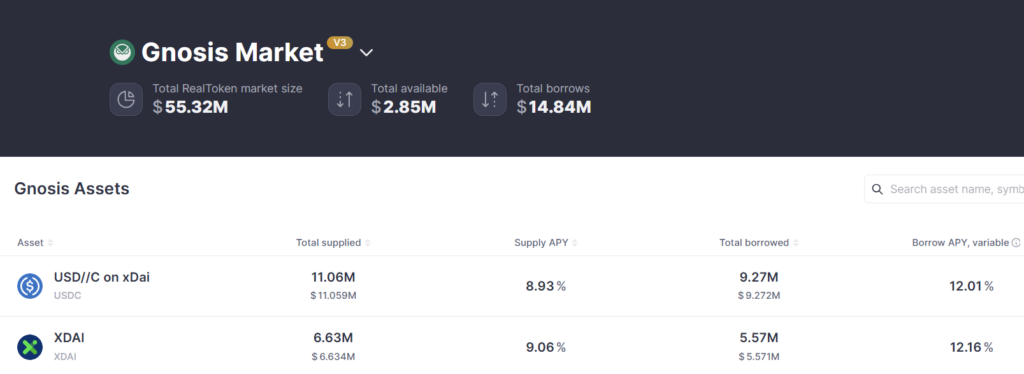
The current math is losing: If you borrow at 12% to place at 9%, you lose money. However, since rates fluctuate, this window could reopen in the future. You must monitor the RMM: if the borrowing rate sustainably drops below 6-7%, the leverage strategy will become a formidable weapon to enrich your portfolio again.
How to get your money back? Liquidity and the YAM
In classic real estate, selling an apartment takes months. With RealT, thanks to the blockchain, it can be much faster, although the current environment has slowed things a bit. Two options are available to resell your tokens.
1. The YAM: The secondary market (RealT’s “Classifieds”)
The YAM (You And Me) is the community exchange platform. It’s a free market where investors trade tokens with each other peer-to-peer.
- The principle: You set your sale price.
- 2026 reality: Historically, new properties on the site sold in minutes. Today, with the economic context and the Detroit crisis, sales are slower. There are fewer rushed buyers, which is also felt on the secondary market.
The current bargain: I’m watching the market. Because of the Detroit crisis, many tokens are currently resold at a discount (cheaper than their real value) by worried investors. For someone who believes the crisis will be resolved, it’s a fairly unique “on sale” buying opportunity.
2. Official buyback by RealT (Security)
If you can’t find a buyer on the YAM, RealT offers a liquidity solution. The platform commits to buy back your tokens (generally within a $2,000 per week limit). The condition? RealT applies a 3% buyback fee. It’s the price of peace of mind: you lose 3% on the sale value, but you are sure to recover your liquidity without managing an ad. It’s a reassuring “exit insurance”, even if the goal remains to keep your shares for the rents.
Practical bonus: Converting your RealT Crypto Rents into Euros (Cash out)
It’s a legitimate question for those leaving “RealToken Wallet” mode to manage their own wallet: how to turn my USDC (digital Dollars) into Euros in my bank account? There are several schools depending on your comfort level with crypto.

1. The “Direct” solution: Mt Pelerin (Ideal for beginners)
For Europeans, the Swiss app Mt Pelerin is often the preferred solution by the RealT community.
- Its asset: It is directly connected to RealT’s blockchain (Gnosis).
- How it works: You send your cryptos to the app, they are converted into Euros, and an instant transfer goes to your bank. It’s smooth and avoids risky technical manipulations.
2. The giants: Binance and Coinbase (For the experienced)
If you already have an account on a big exchange like Binance or Coinbase, you can certainly use them to cash out your rents.
- The advantage: These are robust, secure platforms and you may already have your bank details registered there.
- The nuance: Just be careful about the “network” used for sending. RealT operates on the Gnosis Chain. If your exchange doesn’t support this network directly, you’ll need an intermediate step (a “Bridge”) that can incur some additional transaction fees. Nothing insurmountable, but it requires a bit more handling than the direct method.
3. The “Pro” alternative: Monerium
Finally, for the more seasoned, the Monerium service gives you a real IBAN linked to your wallet. When you “burn” cryptos on your wallet, Euros arrive directly in your bank account. It’s magical and instant, but the interface is a bit more austere for a beginner.
Tools to track your portfolio
Investing on RealT without the right tools is like driving at night without headlights. The basic site interface is functional, but limited.
The Community Dashboard
It’s the essential tool created by the community. By connecting your wallet address, it offers an X-ray view of your patrimony:
- Exact amount of rents per week/month/year.
- Compound interest projection chart.
- Geographical distribution of your properties.
However, while this dashboard is perfect for tracking your rents exclusively, it doesn’t let you see your entire wealth. To centralize your RealT tokens with your stock accounts in one place, I recommend reading my full review of Moning.
The secret weapon of trust: “Community Calls”
Beyond the numbers, what convinced me to remain loyal to RealT (especially during the Detroit crisis) is their communication. Unlike opaque platforms, RealT hosts a weekly Community Call live on YouTube (one week in French, one week in English).
Why it’s unique?
- The founders live: Jean-Marc and Rémy Jacobson are present and take the mic. It’s not a communications officer reading a script.
- Your unfiltered questions (PollUnit): This is where it gets interesting. A few days before the live, the community posts questions via a tool called PollUnit.
- Everyone can vote for the most relevant questions.
- The most voted questions (even the critical or uncomfortable ones) are prioritized and the founders answer them frankly.
It was through this channel that we were kept informed minute by minute of the evolution of the Detroit dispute. It’s a level of transparency I have never seen in traditional investing.
Zoom on the Detroit crisis: The whole truth
It’s probably the most sensitive and debated subject in the community. Rather than beating around the bush, here are the real facts about what is the biggest crisis RealT has faced since its creation.
1. The genesis: A scam that turned into a political conflict
It all started with the failure of a Property Manager (a local company in charge of managing the buildings). Following malpractices and poor maintenance, damage was observed in some apartments.
The City of Detroit then intervened. At first, the founders (the Jacobson brothers), thinking their good faith would be enough, immediately launched remediation works, while financing the missing rents from their own pocket so as not to impact investors. A strong gesture that proves their commitment. But the political calendar got involved: with municipal elections approaching, the City hardened its stance, refusing any dialogue to set an example, which led to an administrative impasse and the blocking of rents.
2. The current situation (2025/2026): Towards an exit from the crisis
Today, the elections have passed and the situation is stabilizing.
- Judicial oversight: The dispute is now under court supervision, which has made it possible to resume dialogue and move away from political arbitrariness.
- The squatter problem: Some tenants took advantage of this legal uncertainty to stop paying or squat the properties. Judicial reassertion will finally allow the necessary evictions.
3. My analysis: A blessing in disguise?
Let’s not kid ourselves: rents were definitely lost in this battle. However, I remain confident for one simple reason: renovation. The recovered (sometimes damaged) dwellings are being completely refurbished. Once the works are finished:
- The market value of the house will increase (capital gain on the token).
- Rents will be re-let at current market rates (better future yield).
It’s a rough patch to get through, but it could end up as a good financial operation upon resale. Important note: This crisis is localized only to a specific portfolio in Detroit. Buildings located in Cleveland, Chicago or Panama are absolutely not affected and run like clockwork.
RealT vs Crowdfunding & SCPI: How I diversify?
I’m often asked whether RealT replaces platforms like Fintown, Tantiem or La Première Brique.
For me, it’s not “either or”, but “both”, because they serve different objectives in my portfolio:
- Crowdfunding (Fintown, La première brique…): It’s often bond-like investment (Debt). You lend money to a property developer for a fixed duration (12 to 24 months). I use it to grow capital in the short term, but I generally only receive the interest at the end.
- SCPI (Louve Invest, Corum…): It’s the “comfort” and regulated solution in France, but with high entry fees (8 to 10%) that wipe out profitability in the first years.
- RealT: I use it for immediate cash-flow. It’s the only asset that pays me an income every Monday, which I can reinvest immediately to keep the compound interest machine running.
🏆 The match: RealT vs French favorite investments
| Criterion | 🇺🇸 RealT | 🇫🇷 SCPI (Corum, etc.) | 🧱 Crowdfunding (Fintown/La première brique) |
| Entry ticket | $50 | ~200 € to 1000 € | 10 € to 1000 € |
| Frequency of gains | ⚡ Weekly | Quarterly | At maturity (In fine) |
| Liquidity (Resale) | Medium (YAM) | Slow (Months) | None (Locked 12-24 months) |
| Entry fees | 0% (included in the price) | 8% to 12% | 0% |
| Currency | Dollar ($) | Euro (€) | Euro (€) |
My strategy is simple: I use French Crowdfunding for euro stability and short term, and RealT to build perpetual passive income in Dollars and boost my overall return.
2026 Balance: Should you get started?
After two years of investing and 71 positions acquired, it’s time for a review. Do I recommend RealT to my close ones? Yes, but with full awareness.
My strategy for 2026 will remain the same: reinvest 100% of rents to benefit from compound interest, but be much more selective about chosen cities (focus on Panama and new areas outside Detroit).
FAQ
No, RealT is a company registered in the USA (Delaware) since 2019. Each real estate property exists physically and is owned by a company (LLC) of which you legally own shares.
The net distributed yield is between 7.70% and 9.20% depending on the properties. This rate can be boosted through reinvestment of compound interest.
The minimum is around $50 (price of a token). There is no subscription or hidden fees upon registration.
Leave a Reply